Product · Brand & experience research
How should the IC Group meet its customers?
One platform, three brands, and more acquisitions ahead. What the consolidators do, what our own teardowns show, and the group structure we propose testing in the UK.
Abstract
Question. Just Go, Bunk and Indie Campers compete for the same customer in London, Edinburgh and Dublin. Every acquisition re-opens the same question and we answer it ad hoc each time. What rule should decide what the customer sees?
What we found. The consolidators differ in one respect that matters: what a brand is permitted to mean: vehicle age (THL), price tier (Enterprise) or segment (Marriott). None runs a single master brand; none runs an unconnected collection. Separately, our own teardowns show a consistent pattern: how much of the product a company owns tracks its interface more closely than brand personality does. We own our fleet, which points to a lean owned-fleet funnel with brands rendered inside it rather than as separate sites.
What we propose. A brand means a value level. Three levels, Premium, Core, Budget, set by a van's features first and its age second. Each brand has one home level and holds it in every market, with a bounded exception where a market has no brand at a level. Vans cascade down the levels as they age and end in RV Sales.
The ask. Greenlight a pilot in the three overlap cities, London, Edinburgh and Dublin, on the measures in Section 6. The structure is argued here; the operating economics and the customer-facing bet are what the pilot would test.
1The problem
Three brands, three websites, cross-visible inventory, no shared account, and no rule for the next acquisition.
Just Go and Bunk compete directly with Indie Campers in London, Edinburgh and Dublin. A customer searching any of those three cities can reach all three brands, see overlapping inventory, and find no relationship between them. Nothing in the current setup decides which brand should win that search, or what the customer is supposed to understand from seeing three of our names.
This is not only an untidiness problem. Each acquisition arrives with a name, an audience and a fleet, and each time we decide what to do with it from scratch. The acquisitions ahead are larger than the ones behind. Whatever we build now defines the slot the next one fits into, so the cost of not having a rule compounds.
What we want is one experience that competes on clarity, price range and choice, without discarding the brand equity we paid for. Those two goals pull against each other, and the tension between them is what this paper is about.
2How we researched it
Four passes: the consolidators, the interfaces, our own catalog, and two prototypes.
2.1.The consolidators:
We studied three groups that solved a version of this problem: Tourism Holdings (maui, Britz, Mighty), Enterprise (National, Enterprise, Alamo) and Marriott. We looked at what each brand is allowed to signify, not at how many brands each runs.
2.2.Interface teardowns:
Live real-browser captures of how Sixt, Marriott Bonvoy, Outdoorsy and British Airways build search, results and checkout, cross-checked against Baymard Institute usability benchmarks. We also captured how Indie Campers, Just Go and Bunk present the same three steps today.
2.3.The live catalog:
We reviewed the real fleet and the real prices to establish what our value levels are, rather than inventing a ladder. Customers already book a category rather than a specific van, and the fleet already sells in quality steps: Original, Standard, Plus.
2.4.Prototypes:
Two results-page directions, four versions in total, plus the shared offer-and-checkout page in three renderings. All built on real fleet and real prices, and interactive in the live versions.
3What the market does
3.1.What a brand is permitted to mean:
The three consolidators diverge on one variable. THL cascades a single fleet through three brands as it ages, so the brand tells you the vehicle's age. Enterprise runs three names at three price points on one shared operation, so the brand tells you the price. Marriott maintains around thirty brands and relies on the membership to unify them, so the brand tells you the segment.
None of the three is a single master brand, and none is a loose collection of unrelated names. But "somewhere in the middle" is not, in itself, a design. What separates them is the meaning each has assigned to a brand, and that assignment is the decision in front of us.
| Group | A brand denotes | What holds it together |
|---|---|---|
| THL | The vehicle's age | One fleet cascading through three names |
| Enterprise | The price point | One shared operation beneath three names |
| Marriott | The segment | A membership across roughly thirty names |
3.2.Where the market sits:
Plotting groups on two axes, how many brands, and whether a membership connects them, the vehicle-rental players all sit low on the connective axis. Multi-brand rental groups exist; multi-brand rental groups with a membership over the top, we found none, and our scan was not exhaustive.
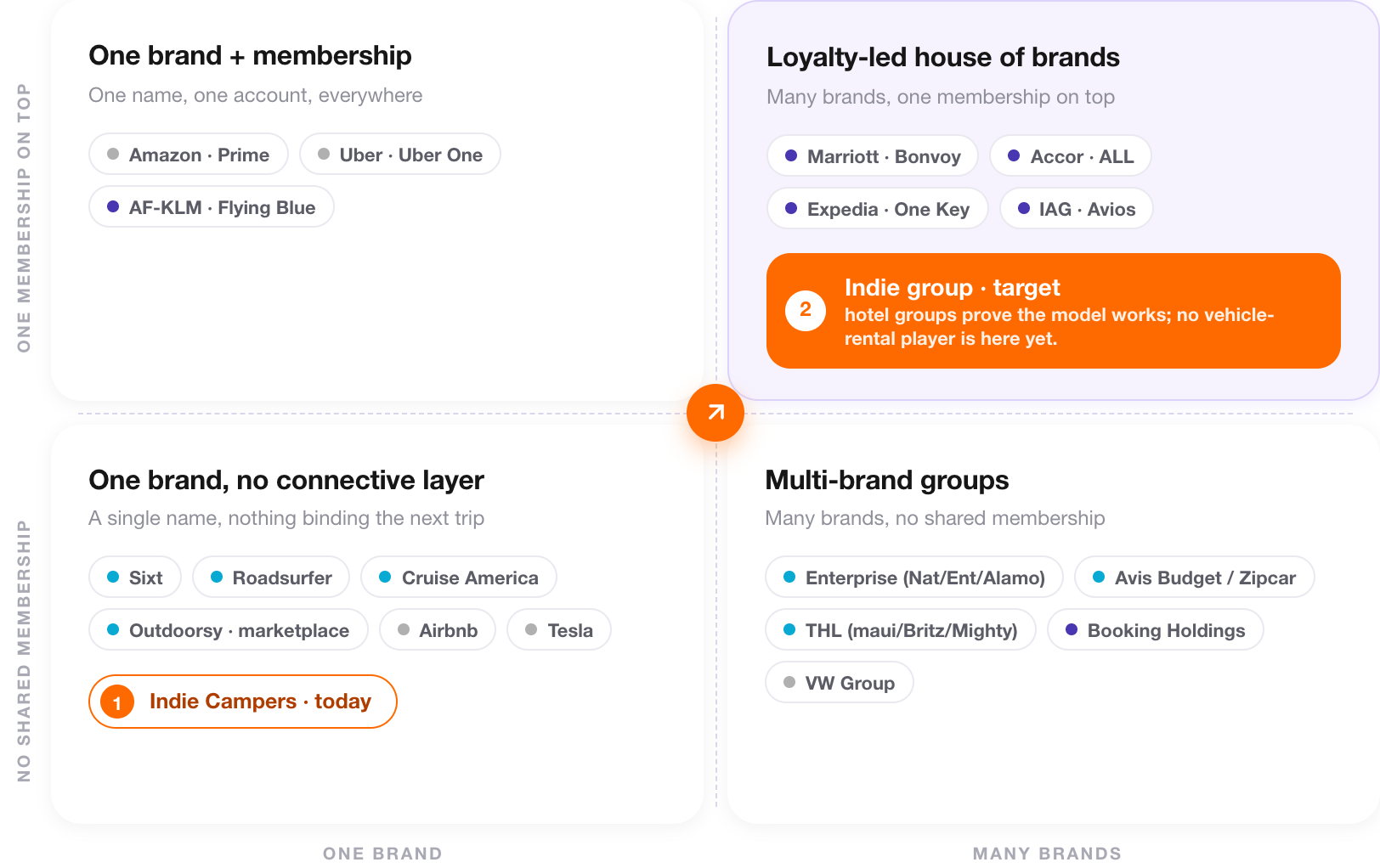
Why that quadrant is empty is worth stating as our reading rather than a finding. Hotel groups do not own the hotels, so adding a brand costs a contract. Rental groups own their fleets, so every brand costs vehicles, depots and capital. The sector is also fragmented enough that no operator has held a portfolio worth connecting. So rental groups accumulate brands and never join them.
The honest counter-reading is that the quadrant may be empty because it does not pay. Campervan rental is lower-frequency than hotel stays, so repeat loyalty is weaker and a membership has less to compound. We return to this in Section 7.
3.3.Supply ownership predicts the interface:
This is the clearest pattern in our own work. The sample is small, one marketplace, one single-brand operator and one loyalty group, cross-checked against Baymard's tested-optimal patterns, so we hold it as a well-supported pattern rather than a proven law. Across those teardowns, one variable tracks how a company builds its funnel more closely than any brand positioning does: how much of the product it owns.
| Model | Owns | What the interface spends on |
|---|---|---|
| Marketplace Outdoorsy, Airbnb | Nothing; aggregates independent supply | Trust. Review scores, host badges, photo-first cards, a map beside the list. Price shown as a full-trip total, because a nightly rate means little when every van differs. |
| Single brand Sixt | The whole fleet | Conversion. The card carries a category, an example model and a price. One decision at a time, then a pay-only step. No trust-building needed, because they can vouch for every van themselves. |
| Loyalty group Marriott Bonvoy | The relationship, not the property | Coherence. Thirty brands under one account, organised by segment, browsed as a portfolio rather than as thirty sites. |
The less of the product a company owns, the more interface it spends on trust, and the deeper its funnel runs. "Or similar" versus a named model is not a wording choice; it signals who owns the fleet, and it can be read straight off the results card.
We own our vans. That points to a lean funnel that is clear on price early and settles every choice before a pay-only step, and at the same time to brands rendering inside one funnel rather than fragmenting into separate sites, which is where the legacy multi-brand groups lose.
4The group model
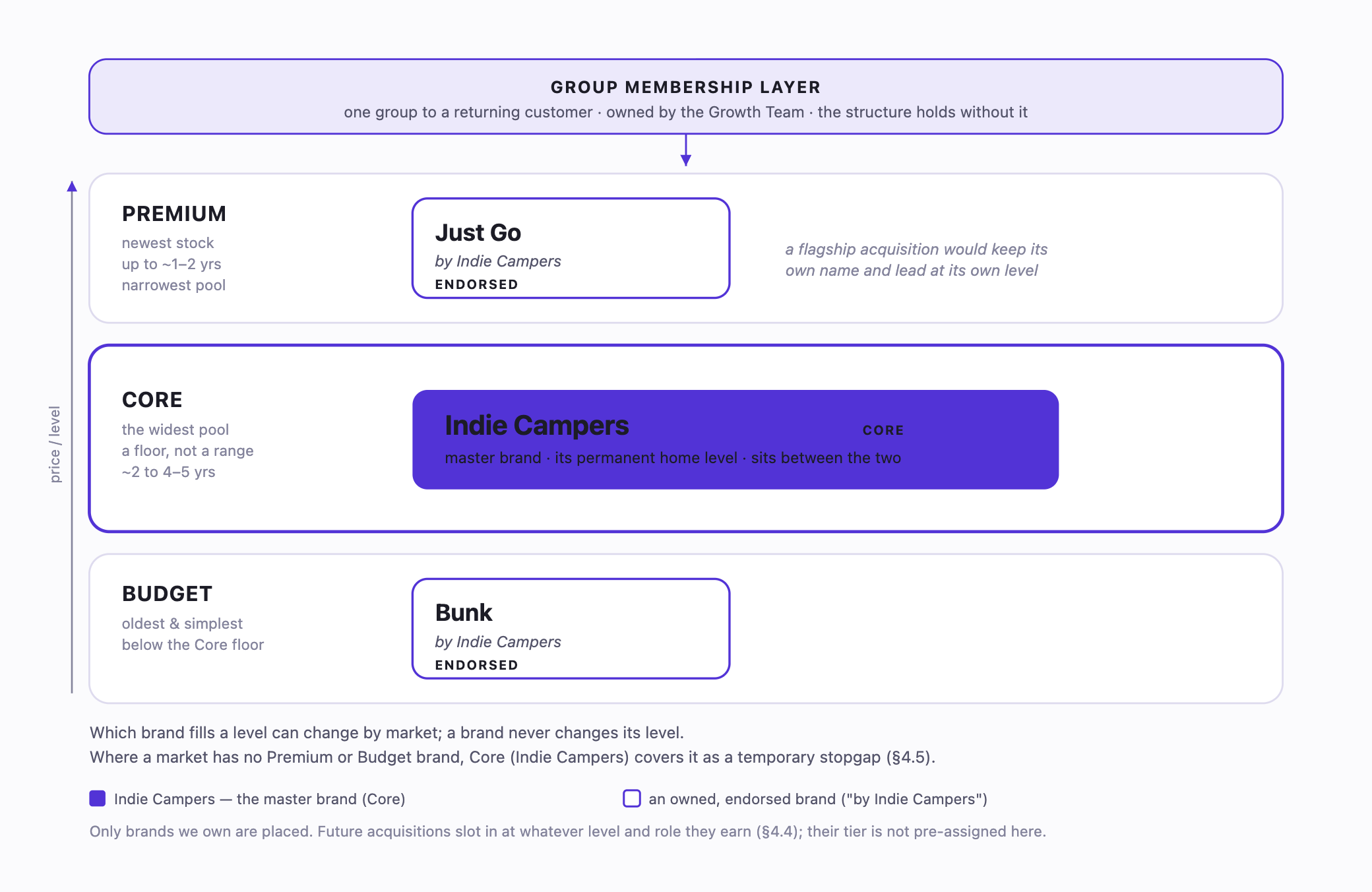
The whole model on one page; the rest of this section explains each part.
4.1.First: why keep multiple brands at all?
Before proposing a structure for several brands, the alternative deserves a straight answer. One brand with three visible levels would be cheaper, simpler and entirely consistent with the rule in Section 4.4 about when a brand earns its place. If the level already carries the promise and the price, and the vans often share a chassis, and the badging has to stay simple enough to swap cheaply, then what is the second name adding?
The case for keeping them rests on three things, and each is documented in the groups that already run this way. First, the acquired names carry demand we would otherwise have to buy again: acquiring a brand buys its audience, its reviews and its search equity, which is why groups keep acquired names distinct rather than folding them in, Accor, for instance, kept Fairmont as its own brand rather than absorbing it (Skift, 2025; Accor). Second, they let us hold a position the flagship cannot occupy without diluting itself: Marriott runs around thirty brands and Accor more than forty precisely because one brand cannot credibly stretch from luxury to economy, brand elasticity has limits (Skift, 2025; Accor). Third, a house of brands gives each future acquisition a slot to fit into rather than a merger to execute.
The same literature marks the other edge, where a second brand stops adding and starts subtracting: undifferentiated proliferation cannibalises the portfolio (FTC working paper, 2011), and the trade press documents the "too many brands" trap, where customers cannot tell the names apart (HOTELSMag). That is exactly why the model keeps a brand only where it is distinct and absorbs it where it is not (Section 4.4).
4.2.Three levels, set by features then age:
A van's level is set by what it has, then by how old it is. Features set the ceiling, the highest level a van can reach, and age carries it down from there over time. So a brand-new van without the premium features belongs at Core, not Premium, and the age bands below are typical rather than defining.
| Level | The pool | What we promise |
|---|---|---|
| Premium | Carries the premium features, newest stock, typically up to 1–2 years. The narrowest pool of the three. | The level we can be most specific about, but not a named model. |
| Core | The widest pool. Holds every type of van: a new one without premium features sits beside a four-year-old one, and beside a premium van that has aged down into Core (Section 4.3), all at the same price, typically 2 to 4–5 years. | A floor, not a range. The category's essentials are guaranteed; the extras that lift one Core van above another, an awning, air conditioning, a private suite, depend on what Procurement buys, so they are upside and never promised. Because a near-new van can sit beside an older one at the same Core price, we can sell a paid "Select" option that guarantees the newest vehicle, turning that spread into an upsell rather than a gamble. |
| Budget | The oldest and simplest vans, below the Core floor. It inherits Core's simpler vans as they age down (Section 4.3), and in some cases an aged premium van, which is sold only as a surprise where the model is not shown. Wide to choose from, narrow in what is inside. | An ordinary category promise. The surprise booking, where the model is not shown, is one option within Budget rather than the promise for the level. |
The floor is what makes Core honest. Because the pool is genuinely mixed, "this category or similar" describes only the shape of the van. The floor describes what is guaranteed inside it, and it is the same sentence in every market.
4.3.How a van cascades:
Features set the range a van can occupy; age carries it down through that range. A premium van cascades openly only as far as Core and is never listed as a named Budget option. Core's simpler vans continue to Budget. The one exception is the surprise pool, where an older premium van can sit because the customer never sees the model and simply receives more than they paid for.
The cascade ends at RV Sales. A customer who rented a van near-new can buy it at the end of its life with us, a cross-sell for the group, not a membership benefit.
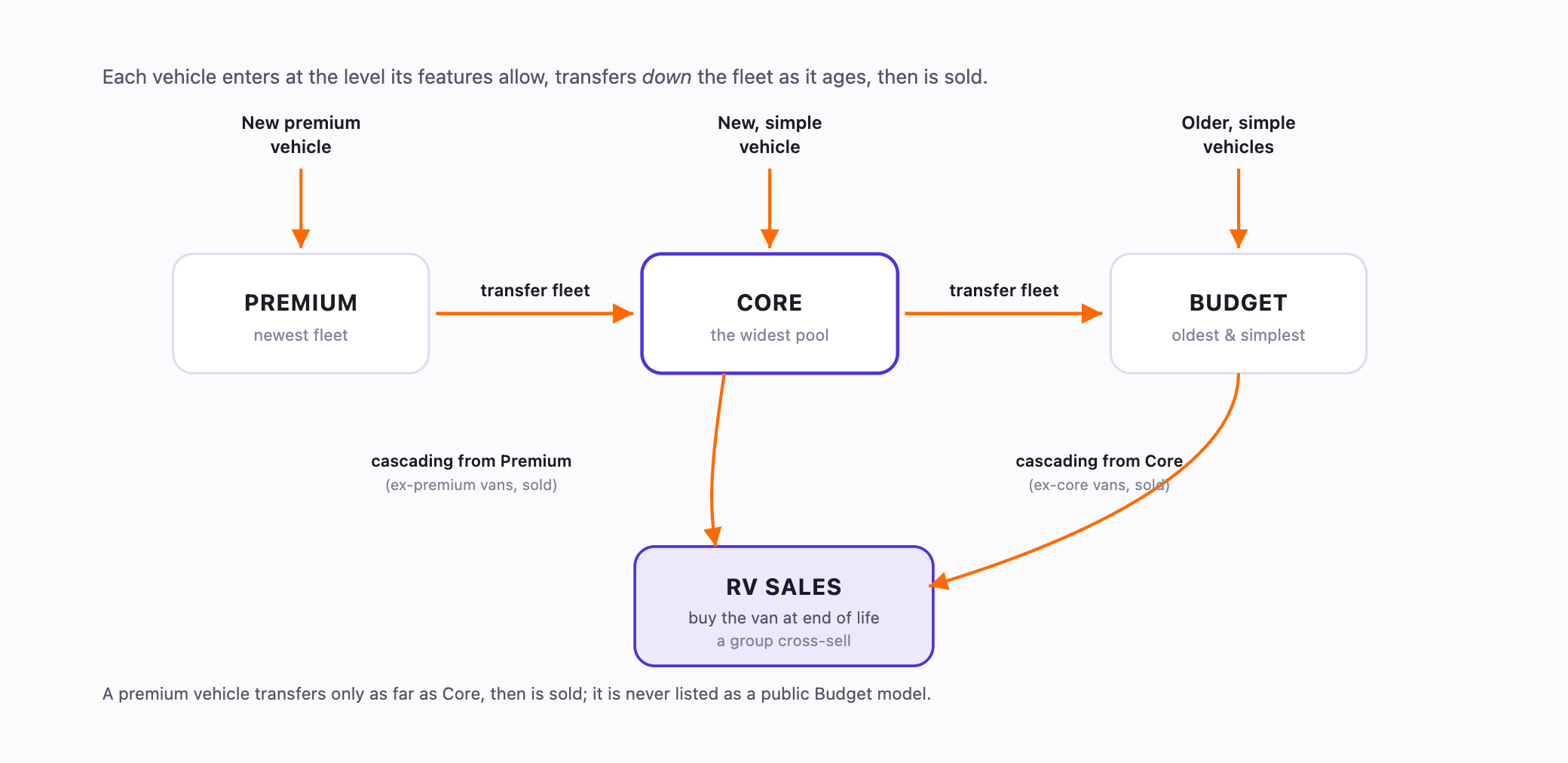
Moving a van down a level is not free: transfer, days off the road, re-badging, re-registration, insurance re-rating, cross-entity transfer, and per-brand photography. Two of those we can bring down ourselves. Standardised swap-badging, a shared base, fixed panel positions, a decal that changes, keeps re-badging cheap, and photography can be reused and re-edited rather than reshot. The trade-off is that badging simple enough to swap also limits how physically different the brands can look, which is the brand question of Section 4.4 arriving from the operations side.
4.4.What each brand is for:
A brand adds value when it holds a position the flagship cannot: a different price level, or a different kind of trip. It becomes noise when it duplicates us on vehicles, market and price, leaving two of our names competing for one customer. That gives a rule for each acquisition.
| Role | When | What happens to the name |
|---|---|---|
| Flagship | Larger than us, or the established name in its market | Keeps its name and leads there, alongside Indie rather than beneath it. We would not diminish it by appending "by Indie Campers". Cruise America or maui, for example. |
| Endorse | Genuinely different, or fills a gap | Keeps its name with "by Indie Campers", drawing on our trust while staying distinct. Just Go and Bunk. |
| Absorb | Substantially the same as a brand we already run | Folded into whichever brand fits. Where it carries a real following we migrate customers gradually rather than retire it abruptly. |
Role is decided per brand, by its size and standing, and holds everywhere: a flagship is a flagship in every market, an endorsed brand stays endorsed. Role and level are independent: a flagship keeps its own name and leads whether that is at Premium or at the value end. We are not fixing the level of any brand we do not yet own; each acquisition takes the level its fleet earns.
Applying the rule to the brands we already own. The three cities in Section 1 are the test case for our own rule. Neither Just Go nor Bunk is larger than us in the UK, so neither is a flagship. Both are endorsed rather than absorbed, on the grounds that each holds a level Indie Campers cannot: Just Go a newer and better-equipped fleet, Bunk an older and simpler one. They are not duplicates of us, and under Section 4.2 they sit at opposite ends of the ladder with Indie Campers between them.
It is worth being explicit that this is also the convenient answer. The test that would falsify it is in Section 4.1: if branded demand for either name turns out to be small, the rule points at absorb rather than endorse, and the portfolio should shrink before the website changes.
4.5.The rule, and its one exception:
The rule. Two things that sound alike but point opposite ways. A brand's level is fixed: Bunk is Budget and Just Go is Premium, in every market. A level's brand is not: which brand fills a given level can differ from market to market, even city to city, because not every brand operates everywhere. So the occupant of a level can change, but a brand's own level never does.
The exception. Where a market has no Premium brand, the Core brand also runs Premium, pricing premium vans as premium and keeping Premium's own promise. One brand covering two levels, not one blurred level, and not a change of home level. The same applies to Budget. Alternatively we leave the level empty, or introduce a brand for that region alone. It is a stopgap, and how far to use it is a judgement call for Section 8.
The cost of the rule: Indie Campers' home level is Core, permanently. The exception lets it cover premium demand where no premium brand exists yet, so no demand is lost, but the group's own name never owns the premium position as a lasting identity; that belongs to another brand. There is a second cost worth naming: a brand covering two levels is a bounded version of the very stretch Section 4.1 warns against, so the exception carries a small amount of the dilution the multi-brand structure exists to avoid. That is why it is a stopgap and why Section 8 puts a limit on how far and how long it runs. It is a real price, and it should be paid deliberately rather than discovered later.
4.6.The single assumption:
A group-level membership connects the brands. Bruno Eusébio's Growth Team owns it as a separate project; this paper assumes it exists and leaves the mechanics to them.
Worth stating plainly, because it affects how safely this can be backed: the structure does not depend on the membership succeeding. One platform, one product standard, the level ladder and the cascade into RV Sales all hold on their own. The membership makes the group read as one thing to a returning customer, and it is what would make the position in Section 3.2 genuinely distinctive rather than just another multi-brand group; but it is the upside on top, not what makes the structure work.
5What it looks like built
Two directions, prototyped on the real catalog. Both run on the same platform, standard and membership; the difference is what the customer navigates first.
5.1.Display 1, product at the centre:
One card per product available in the searched location, with a three-way level selector inside it. Each level tile carries its image, promise, the brand that fulfils it, price and total, and its own call to action. Version A shows every tile at once; version B discloses on tap.
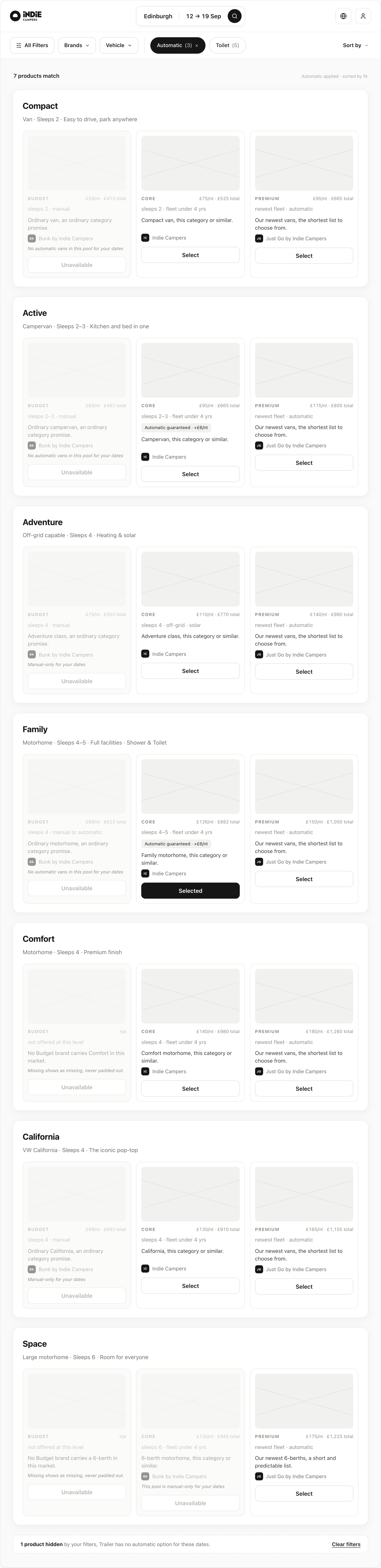
Filters behave as constraints with visible costs: count pills show what a filter will cost before it is tapped, filtered tiles grey out with a reason instead of vanishing, repricing is printed explicitly, and version B recomputes its "from" price so it never lies.
5.2.Display 2, brand at the centre:
Shelves organised by the kind of trip, each title a level promise in lifestyle language with the auditable spec printed beside it, and the brands masked into the shelf as the names that fulfil it. Version B goes further and lists the brands themselves, hotel-group style, with model selection deferred to the brand's offer page.
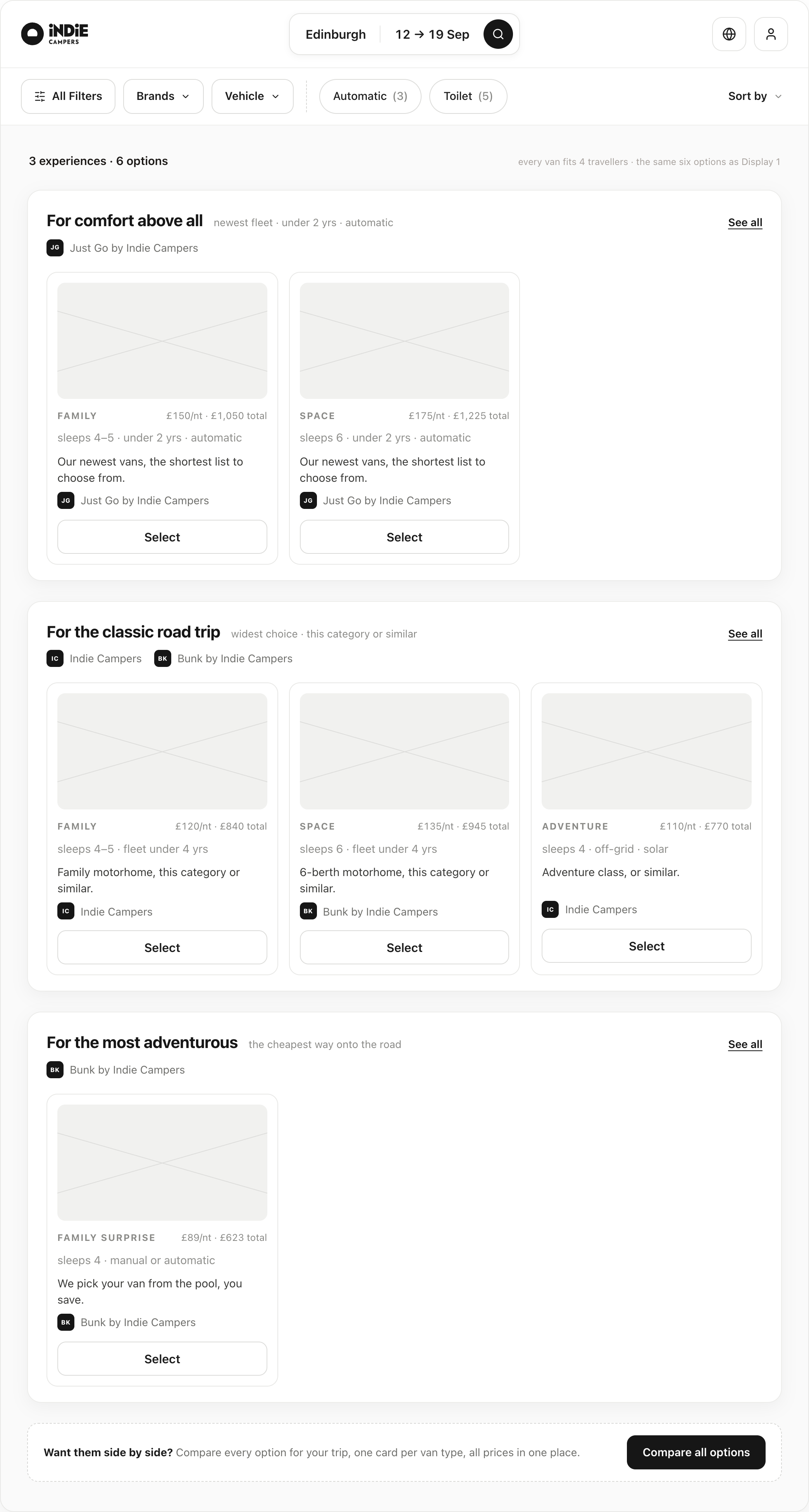
The case for it: we bought Just Go and Bunk partly for their audiences, and a flat product grid discards that. First-time campervanners tend to shop by the kind of trip they want rather than by specification, and every future acquisition slots in as another experience rather than another logo to reconcile. The honest risk is that the price ladder is split across shelves, and that version B adds a step for anyone comparing prices in the overlap cities, worse under the Section 4.5 exception, where the same brand can appear twice at two prices.
5.3.The shared step:
Both directions land on the same page: offer and checkout merged, so payment is isolated to payment. Shown in three renderings (one canvas, a guided wizard, a configurator) as evidence the merge is achievable and not an irreversible commitment. It is not a decision for now.
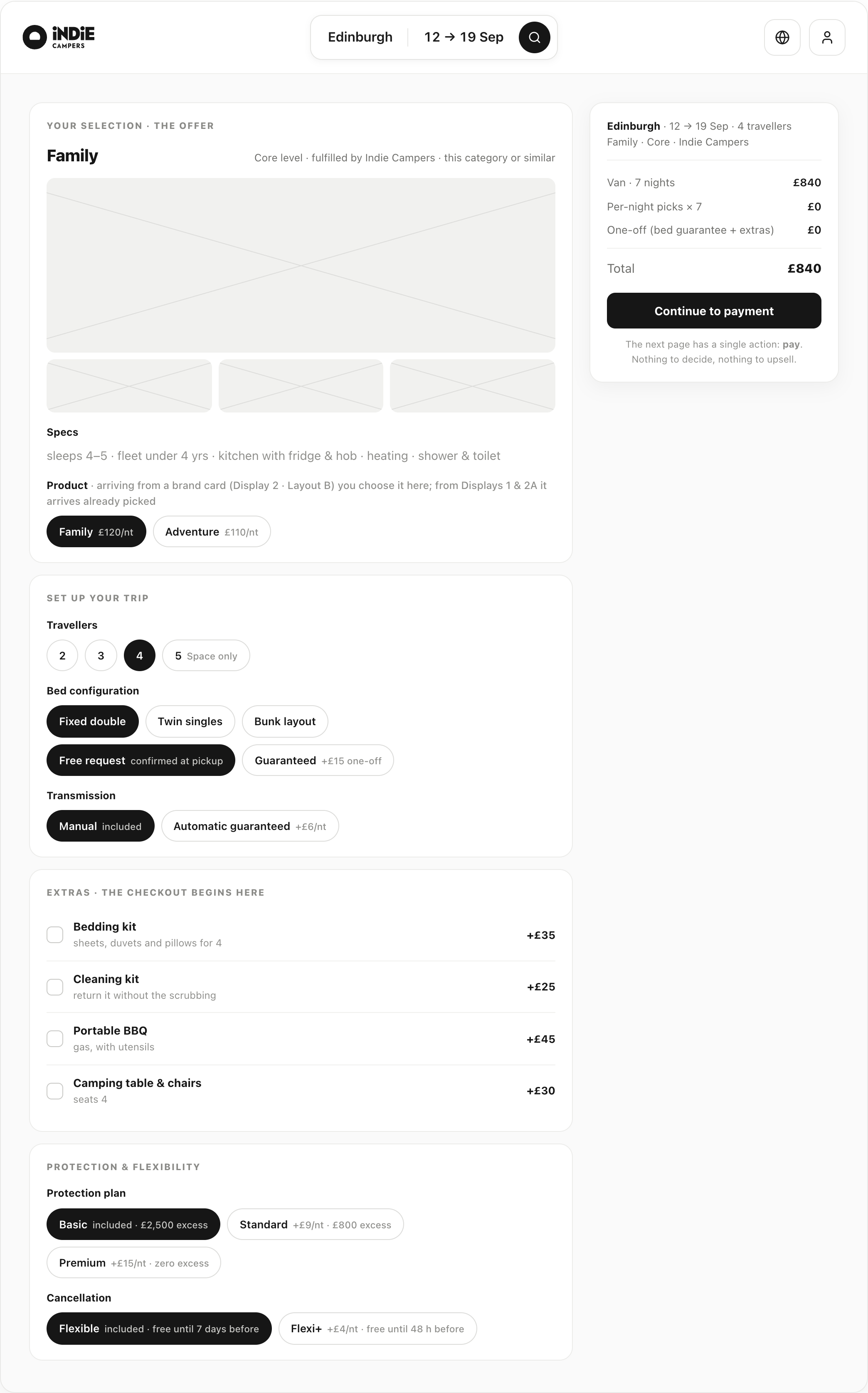
5.4.Our recommendation, and how we would learn:
Our recommendation is to start with Display 1, and the reasons are concrete rather than a hunch: it follows the owned-fleet interface pattern (Section 3.3), it puts the whole ladder on one comparable page so a customer can trade up, it needs no extra step to compare, and it handles the Section 4.5 exception cleanly, when one brand sells at two levels, the level does the talking and the badge rides along. It is a lean, not a lock, and the pilot is what settles it.
The measurement plan needs one correction. The compare-pivot is a Display 2 control: it exists to reassemble the ladder from shelves. If we build Display 1 first, there is nothing to pivot from, so it cannot be our measure of brand-attached demand. On a Display 1 page the equivalent signals are brand filter usage, entries arriving via the brand sites and where they convert, and the share of sessions that engage the brand dropdown at all. If we want the compare-pivot itself as a measure, Display 2 has to run somewhere, which is a second, later decision.
6If we commit
6.1.The pilot:
The three cities where all three brands overlap: London, Edinburgh and Dublin, which spans the UK and Ireland (two jurisdictions, which the cross-entity and legal clearance below already has to cover). The hardest case is the truest test. Before a customer sees anything, three things have to be settled: the level definitions, the Core floor per category, and the results page.
Three workstreams sit outside product and need owners now. The acquired brands' sites and search equity are an asset to preserve rather than redirect away, and each brand's paid accounts carry their own history. Cross-entity vehicle transfers, per-market brand and endorsement use, and data sharing across the group need legal clearance. And a swappable badging system, common wrap base, fixed panel positions, replaceable decals, belongs with fleet ops; it is flagged here, not taken on.
6.2.How we would know it worked:
Measures to agree and baseline before launch, not after, on roughly a one-year horizon. The overlap cities are a small sample and earlier reads will be noise.
| Measure | What it tells us |
|---|---|
| Search-to-booking conversion in the overlap cities | Against those same cities today. |
| Share of bookings where the customer saw more than one of our brands | Whether the group reads as one range or three funnels. |
| Repeat customers booking a different brand, and the booking mix across levels | A Premium level that barely sells means the ladder is not earning its keep. |
| Traffic via the acquired brands' own sites, and its conversion | Whether the equity we paid for still works. |
| Average booking value | Whether the ladder quietly became a discount. |
| Complaints about which van turned up | The direct test of whether the Core floor is a real promise. |
| Cost per cascade step | Whether the fleet movement the model assumes is affordable. |
7Limitations
What this paper does not establish, and what would change our view.
The customer-facing bet is untested. No customer has seen either display. The prototypes demonstrate that the structure can be built; they are not evidence that it converts better than three separate sites. Everything in Section 5 is a hypothesis with a test attached, not a finding.
The consolidators are analogy, not proof. THL, Enterprise and Marriott show what is possible in adjacent industries. They do not establish what works for a campervan business with our fleet, our frequency and our markets. They generated the hypothesis; they cannot confirm it.
Frequency may not support a connective layer. Campervan rental is lower-frequency than hotel stays, so a membership has less to compound. Our reading is that the layer pays off by holding the portfolio together and cross-selling the ventures rather than through repeat rental, but that is the Growth Team's thesis to prove, not ours.
Frequency also bears on the case for keeping the brands at all. The Section 4.1 argument assumes acquired-brand equity, audience, reviews, search, repeat demand, persists in a low-frequency category the way it does in hotels. If frequency is low enough that it does not, the case weakens for the structure itself, not only the membership. This is not something we should defer wholesale to the pilot: branded and direct traffic and repeat rates for Just Go and Bunk are first-party figures we already own and can approximate before any build. That check, not the display or the membership, is the true go/no-go on a multi-brand structure, and Section 4.1 states the honest fallback if it comes back weak.
The economics are unpriced. Cascade cost per step, level pricing and resale recovery are all assumed workable. This paper commits a structure, not a set of numbers.
Two sources are thinner than the weight put on them. The FTC paper on hotel brand cannibalisation is a working paper, and the HOTELSMag piece is trade commentary. Both are cited as illustration below, and neither should be read as settling the question.
What would change our view. If branded demand for Just Go and Bunk turns out to be small (Section 4.1), the honest conclusion is a smaller portfolio rather than a better display. If cascade cost per step is high relative to the price gap between levels, the ladder does not pay and the levels should be fewer.
8The decision
What we are asking for
Greenlight a pilot in the three overlap cities (London, Edinburgh, Dublin), built on this structure: one connected group, three levels set by features then age, each brand holding one role and one home level, a Core floor, and the fleet cascading into RV Sales.
Two judgement calls sit inside that and belong to you, not to us. First, the default where a region has no brand at a level, cover it with Core, leave it empty, or acquire one even for a single city. Second, how long the Core exception is allowed to run before a level is filled properly. Both are capital and M&A calls.
Backing the pilot is not backing the display. Display 1 is our recommendation and the reasoning is in Section 5.4, but that decision can wait until the structure is settled.
9Sources
- Tourism Holdings (thl), official brand structure: maui, Britz and Mighty span premium to value on one fleet; the age-based cascade across the three is as publicly described. Cited in Section 3.1, Section 4.3. thlonline.com/businesses
- Enterprise Mobility, official brand portfolio: Enterprise (flagship), National (premium) and Alamo (value) on one shared operation. Cited in Section 3.1. enterprisemobility.com
- Skift, 2025, "Every one of Marriott's hotel brands, explained" (around 30 brands). Cited in Section 3.1, Section 3.3, Section 4.1. skift.com
- Accor, 45+ brand portfolio across luxury to economy. Cited in Section 3.2, Section 4.1. group.accor.com
- HOTELSMag, "hotel brand families should focus on differentiation, not addition". Trade commentary; illustrative only, see Section 7. Cited in Section 4.1. hotelsmag.com
- US Federal Trade Commission, Bureau of Economics working paper no. 309, 2011, "Branding, Cannibalization, and Spatial Preemption: An Application to the Hotel Industry". Working paper; illustrative only, see Section 7. Cited in Section 4.1. ftc.gov
- Live real-browser teardowns of Sixt, Marriott Bonvoy, Outdoorsy and British Airways, cross-checked against Baymard Institute usability benchmarks. Full teardowns on file. Cited in Section 3.3, Section 5.4. On the "or similar" class model: sixt.com; benchmarks: baymard.com
- Indie Campers live catalog and price list, August 2026. Cited in Section 2.3, Section 4.2.
- Internal booking behaviour (the price-led read): a qualitative internal signal, to be quantified in the pilot, see Section 5.4.
- Internal brand-demand for Just Go and Bunk (branded traffic, repeat rate, price premium): to be produced in the pilot, see Section 4.1.
maui (THL) and Cruise America are acquisition intents, not owned assets. Supporting material, two research passes, the four-lens stress test, the naming pre-screen and the full teardowns, on file.